Why Shinjuku's Neon Won't Let You Go: The Real Reason American Tourists Keep Coming Back
I've talked to a lot of Americans who've visited Shinjuku. And there's a pattern that shows up in almost every conversation, regardless of age, background, or what they were originally in Tokyo for.
They went once. They're already planning to go back. And when they try to explain why, they usually land on something vague — "the energy," "the vibe," "it's just different." Which is true, but it's also a non-answer that raises the more interesting question: different how, and why does that difference create something that feels closer to compulsion than preference?
I think there's a real answer here, and it lives at the intersection of sensory psychology, cultural design, and the specific way Shinjuku has built its entertainment identity over decades.
The Sensory Overload That Doesn't Feel Like Overload
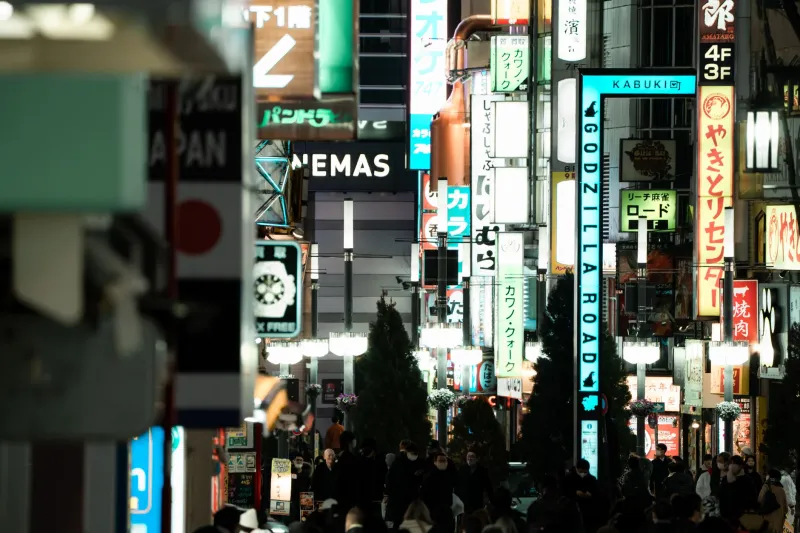
Let's start with the obvious: Shinjuku is a lot. The neon signage in Kabukicho and along the entertainment corridors isn't just ambient — it's aggressive, layered, competing for attention from every angle simultaneously. Screens flash. Speakers project music from venue doorways. The smell of yakitori smoke mixes with the cool night air. Crowds move in every direction without apparent pattern.
By any reasonable measure, this should be exhausting. And yet, most American visitors describe the experience as energizing rather than draining. Why?
The psychological concept at work here is something researchers call optimal stimulation level — the idea that people have a preferred range of sensory input, and that being at the high end of that range (without crossing into genuine overwhelm) produces a state of heightened alertness and positive arousal. Shinjuku, almost by design, operates right at that upper threshold for most visitors.
The critical element is organization within the chaos. The streets are crowded, but they're navigable. The signs are overwhelming in aggregate, but each individual one communicates clearly. The music from competing venues creates noise, but it's rhythmic noise. Your brain is processing an enormous amount of information, but it's information that has structure. That's the sweet spot — maximum stimulation, minimum genuine confusion.
American entertainment districts, by contrast, tend to optimize for accessibility and safety in ways that inadvertently reduce stimulation. Think about the Las Vegas Strip, which is the closest US equivalent many visitors reach for. The Strip is big and bright, but it's also heavily managed — wide sidewalks, clear signage, predictable layouts. It's stimulating without being surprising. Shinjuku surprises you constantly, and that surprise is part of the hook.
Escapism With a Specific Flavor
There's another psychological mechanism at work that I think gets underappreciated in conversations about Tokyo tourism: Shinjuku offers a very particular brand of escapism that's different from what most American entertainment districts provide.
Escapism, broadly, is about temporarily suspending your ordinary identity and context. Vegas does this through excess — you escape by becoming a version of yourself with more money, fewer consequences, and a different schedule. Theme parks do it through narrative — you escape into a story that's been constructed around you.
Shinjuku does it through cultural displacement. You escape by being genuinely, authentically somewhere that operates on different rules, different aesthetics, different social codes. The escape isn't manufactured — it's real. You're not in a simulation of another world. You're in another world.
For American visitors specifically, this distinction matters. The US entertainment industry is extraordinarily good at producing experiences — curated, optimized, focus-grouped. But those experiences, however impressive, carry the fingerprints of their own construction. You can feel the design decisions. In Shinjuku, the entertainment culture evolved organically over decades, layering host clubs over jazz bars over pachinko parlors over live music venues over ramen shops, and the result is an environment that feels genuinely alive rather than produced.
That authenticity — even in a place that's undeniably commercial — is increasingly rare, and increasingly sought after.
The Social Architecture of Shinjuku Nightlife
Here's something that doesn't get discussed enough: Shinjuku's entertainment district is designed, at a deep structural level, for participation rather than observation.
American nightlife culture has gradually shifted toward a more passive model. We go to venues to be entertained, to document the experience, to consume. The expectation of active participation — of being genuinely in the room rather than watching it — has diminished.
Shinjuku resists this. The host and hostess club culture that defines significant portions of the district is fundamentally built on conversation and relationship, however transactional. Live music venues expect audiences to engage with performers. Even the street-level chaos of Kabukicho at 11 PM is participatory — you're not watching the crowd, you're part of it.
For American visitors who've grown accustomed to experiencing nightlife from behind a phone screen, being pulled into genuine participation can feel startling at first, and then addictive. You remember nights where you were actually present in a way that's become rarer at home.
Why the Lights Specifically
Let's come back to the neon, because it deserves its own moment.
Neon signage in Japan — and in Shinjuku particularly — functions differently than it does in Western contexts. In the US, neon is largely nostalgic signaling, evoking diners and roadside motels and a particular mid-century aesthetic. It's warm and retro.
In Shinjuku, neon is present tense. It's not evoking anything — it's simply the visual language of now. The density of signage, the layering of kanji characters and English words and brand logos and directional arrows, creates a visual environment that's simultaneously legible and illegible to Western visitors. You can read some of it. Most of it you can't. And that partial legibility creates a specific cognitive state — engaged enough to keep trying, uncertain enough to stay alert.
Neurologically, this is similar to what makes certain video game environments compelling. You're in a space with rules you're still learning, processing information at high speed, occasionally succeeding at reading the environment and occasionally failing. That cycle of partial comprehension and continued effort is deeply engaging for the human brain.
The lights aren't just pretty. They're a puzzle you never quite finish solving.
The Honest Answer
So why do American visitors keep coming back to Shinjuku? Because it offers something genuinely scarce: a sensory environment calibrated to the edge of overwhelm, an escape that's culturally real rather than manufactured, a social culture that demands participation, and a visual landscape that keeps your brain working.
We talk a lot about "authentic experiences" in travel, and the phrase has been diluted to meaninglessness by overuse. But Shinjuku at night — with its neon and its noise and its particular energy — is the real thing. It's a place that exists on its own terms, that wasn't designed for you specifically, and that will be exactly the same whether you show up or not.
And somehow, that indifference is the most appealing thing about it.
You come back because Shinjuku doesn't need you to. But it's glad you're here.